
Knowledge discovery
Summarization is not knowledge discovery.
Summarization finds what someone already discovered and wrote about. Knowledge discovery finds novel information that has not been researched or written about yet.
Knowledge discovery is “the nontrivial process of identifying valid, novel, potentially useful, and ultimately understandable patterns in data.”
“Blind application of data-mining methods … can be a dangerous activity, easily leading to the discovery of meaningless and invalid patterns.”
Correct, Coherent, and Unusable
Knowledge discovery moves beyond accuracy.
An answer can be correct and coherent, while being completely useless in a certain context.
- Correct
- The numbers match the data, and the math checks out.
- Did we calculate this right? Did we use the right formulas?
- valid valid on new data with some degree of certainty.
- Coherent
- It hangs together, makes sense, and reads like an answer.
- Does it make sense on its face?
- ultimately understandable understandable immediately or after some processing.
- Usable
- Someone can make a decision, in context, without being misled.
- Did we answer the right question, for this person’s context?
- potentially useful lead to some benefit to the user or task.
Coherence hides errors
Human raters “are more trusting of assertive responses, and are less likely to identify factuality or inconsistency errors within them.”
Correct, Coherent, Definitely Not Usable
Correct and coherent is dependent on context.
The math can hold up logically, and the result can “pass the smell test,” but subject matter expertise and context can still reverse the conclusion.
What is the total patient population across all of our service areas?
- 42,000
- 35,000
- 28,000
- Combined population Is this correct?
- 105,000
- Counted more than once
- −24,000
- Each person counted once
- 81,000
Useful Must exclude people in zip codes that are counted more than once (some counted three times!).
When and why this happens
Utility rests on judgment, not mechanics.
Great analysts can make these mistakes on a bad day. AI makes them at scale and speed.
- Layer What we assume What breaks the assumption
- Framing The answer arrives in a form the end user expects and can use. Delivering the wrong format.
- Method The parts of the analysis combine to address the question. Stopping short of the full picture.
- Data The data we have can be used to address what the user needs. Assuming the data is complete.
- Measure What we plan to measure aligns with the right discovery need. Some data is better than no data?
- Context We understand why the ask matters and learn things not derivable from data. Trusting only in the data.
- Ask We discover the underlying questions AND the intent. Answering the wrong question.
Lesson 1
Accurate is not the right bar.
Accuracy is where evaluations start, but not where they end.
-
Correct
Does the number match the data, and “is your math mathing?”
Factual, relatively cheap to automate. A mix of determinism and agentic review.
Evaluated by Code + agents
-
Coherent
Does it hold together and read like an answer based on the underlying facts?
Structural. LLMs and agents can judge this but it's subjective to the reader and their context.
Evaluated by Agents (imperfectly)
-
Usable
Does it answer the actual need (not just the question) discovered? Can it drive action?
Qualitative. Takes context, judgment, and someone to connect the agent and findings to the real world.
Evaluated by Humans with context
Lesson 1
Evaluate for utility, not just accuracy.
Useful is measurable, but it takes someone with context and expertise to judge it.
-
Users
Bake context into each conversation.
- Use/define skills and agents to describe the Ws: who, what, why, etc.
- Give agents permission to come back and clarify instead of guess.
-
Builders
Determinism + user-driven evals.
- If it can be done in code, do it in code first.
- LLMs as judges can only take you so far. Build interactive ways for users to join the evaluation.
-
Organizations
Reward value over volume.
- Put expertise upstream to help shape the work, not become a consequence of it.
- Deploy the right incentives: outcomes with real impact vs. volume and corporate slop.
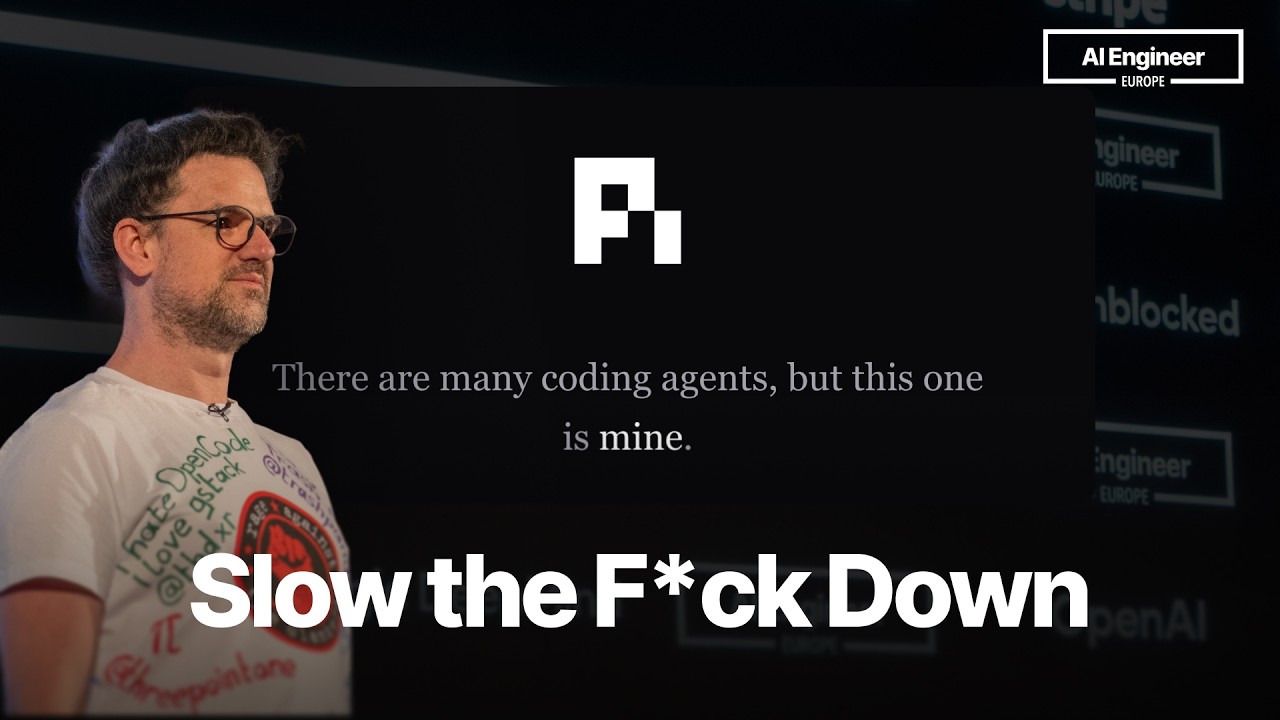 Play Mario Zechner’s talk “Building pi in a World of Slop” at 16:12, on YouTube
Slow the **** down.
Mario Zechner, creator of the pi.dev coding harness, advocates for capping what you generate to what you can genuinely review, and writing the important things by hand. This applies to everything, not just code. While humans can also make mistakes, agents make mistakes at scale and speed. Much faster than any team can reasonably understand or correct.
Lesson 2
Approved does not mean reviewed.
Human in the loop (HITL) is not an effective strategy and shifts the burden on the user.
-
97%
of HITL requests are approved
When a genuinely dangerous command was hidden in the stream, people caught it only 13.6% of the time, about 17% early in the session and about 5% later on.
Anthropic, “Auto mode is now the default in Claude Code”, 2026 vendor (opens in a new tab)What it shows Attention is consumable and degrades quickly. -
83.4%
agreed to give up a kidney
Of 500 participants that opened a terms of service document, only four mentioned the clause of pledging a kidney. This likely means “496 of 500 participants (99.2%) did not notice the clause.”
Obar & Oeldorf-Hirsch, International Journal of Communication, 2022 (opens in a new tab)What it shows “I agree” has never meant “I understand.” -
1.2 sec
per claim signed by a physician
Cigna medical directors denied more than 300,000 claims in two months. Claims that required a physician signature. A former Cigna doctor: “We literally click and submit.”
ProPublica, “How Cigna Saves Millions by Having Its Doctors Reject Claims”, 2023 (opens in a new tab)What it shows When given the option, we trust the system.
“… the moral crumple zone protects the integrity of the technological system, at the expense of the nearest human operator.”
Lesson 2
Human in the RIGHT loop.
We have to stop asking users to pay attention to things they don’t care about.
Lesson 2
Make approval mean something.
Human involvement has to be more than a checkbox. Use their expertise, not their click finger.
-
Users
Tell agents how to involve you.
- Ask to see more than a plan: SBAR (situation, background, assessment, recommendation).
- If you don’t understand what you’re checking or why, stop and find out.
-
Builders
Users at the right, higher altitude.
- Automate low-value approvals and avoid training the reflex.
- Capture context up front, enforce Socratic questioning and communicate with users in a way they understand.
-
Organizations
Accountability stays human.
- Name what the human is responsible for evaluating, and incentivize that.
- Amplify and expand institutional knowledge in your people. AI can enhance critical thinking, not replace it.
When we think about AI, we only think about the destination. We only think about the output, we never think about the input.
Lesson 3
Show the work...at the right level.
“Observability” has to move beyond “do you agree with the code” to “does this accomplish what you intended?”
Show the code/plan. The user will figure it out.
Let the user judge the outcome, not the process.
“Agents quietly commit to plausible but unintended task framings, producing clean, executable artifacts that hide their incorrect assessment of the task …”
Lesson 3
Help humans judge composition over process.
Ask users to react to the whole essay, not go hunting for typos.
Users
Engineer engagement throughout the conversation.
- Ask to be involved around claims and assumptions, not code or sources.
- Integrate critics that automate the first line of review, and consider what would have to be true for the answer to be wrong.
Builders
Build for navigating knowledge over code.
- Build interfaces that help users navigate knowledge graphs.
- Fail visibly with informative errors that can help capture additional context.
- Make assumptions an object users can challenge, not prose they have to catch.
Organizations
Decide what decisions must rest on.
- Formalize what supporting evidence in the age of AI means for your most critical decisions.
- Hold the same standard whether a person or an LLM produced the work.
- Give employees the ability & time to meet that same standard.
A feature, not a bug
Vendors should have a stake in the game.
Instead, vendors today promise uptime and pass the risk onto the consumer.
-
OpenAI
You must evaluate Output for accuracy and appropriateness for your use case, including using human review as appropriate…
OpenAI, Terms of Use, effective January 1, 2026 (opens in a new tab) -
Microsoft
Always verify the accuracy of information presented by Copilot before you rely on it. We are not responsible for any consequences…
Microsoft, Copilot Terms of Use, effective August 18, 2026 (opens in a new tab) -
Anthropic
Factual assertions in Outputs should not be relied upon without independently checking their accuracy, as they may be false, incomplete, misleading…
Anthropic, Commercial Terms of Service, effective June 17, 2025 (opens in a new tab) -
xAI
You should conduct your own thorough research and should not rely on Output as the truth.
xAI, Terms of Service – Consumer, effective June 26, 2026 (opens in a new tab) -
Perplexity
You should not rely on the Services or any Output for advice of any kind…
Perplexity, Terms of Service, last updated January 23, 2026 (opens in a new tab) -
Google
Don’t rely on the Services for medical, mental health, legal, financial, or other professional advice.
Google, Gemini API Additional Terms of Service, last updated April 28, 2026 (opens in a new tab)
“The most accurate analysis, with the best visuals, delivered in the perfect format, will still fall on its face if who delivers it can’t read the room.”
Bring this to your team.
We build agentic systems for a living, and run an AI fluency program for healthcare and technology leaders bringing AI to the enterprise. If you are working out what your own blast radius looks like, this is a conversation we have often.